What Is Direct Deposit? (How It Works, Pros and Cons, and How to Set It Up)
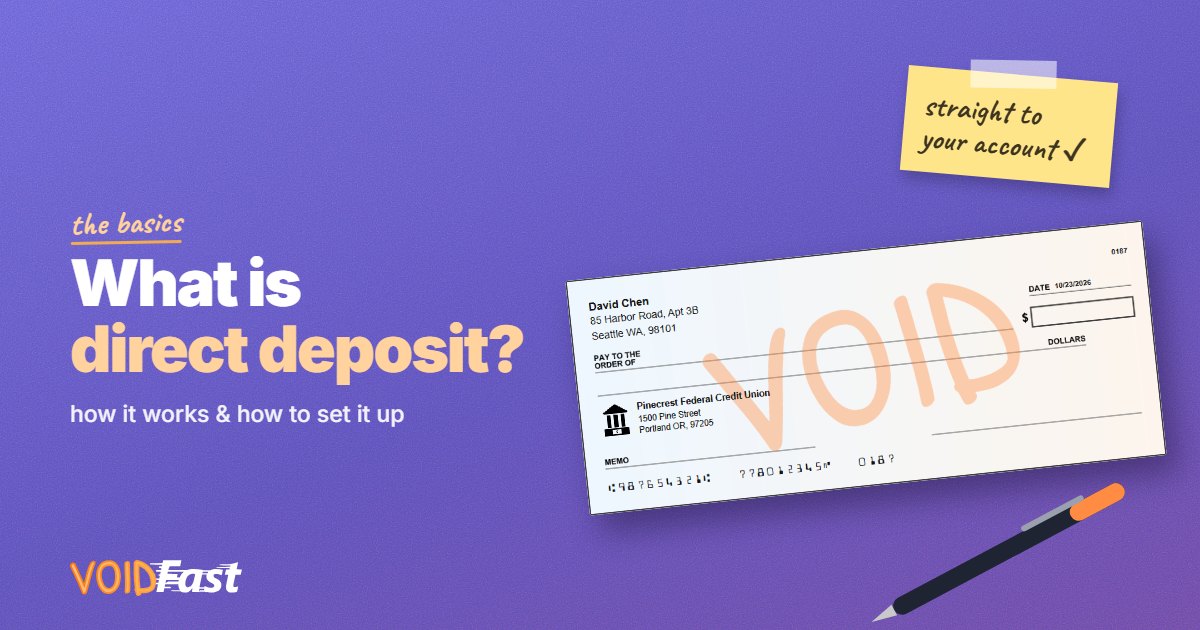
Most people in the U.S. get paid by direct deposit instead of a paper paycheck. It's also how many people receive tax refunds and government benefits. Here's what direct deposit is, how the money gets from your employer to your account, what you need to set it up, and the pros and cons.
Quick answer: direct deposit is an electronic payment sent straight into your bank account, usually through the ACH network. Your employer (or another payer) needs your bank's routing number, your account number and the account type. You give them on a direct deposit form or a voided check, and after setup — often one or two pay cycles — your pay arrives automatically every payday.
What is direct deposit?
Direct deposit means a payer sends money electronically into your checking or savings account. There's no paper check to pick up, sign or take to the bank: the money simply appears in your account on payday.
It's used for much more than paychecks:
- wages and salaries from employers
- federal tax refunds from the IRS
- Social Security and other government benefits
- pensions, unemployment benefits and some insurance payments
- payouts from apps and gig platforms
How does direct deposit work?
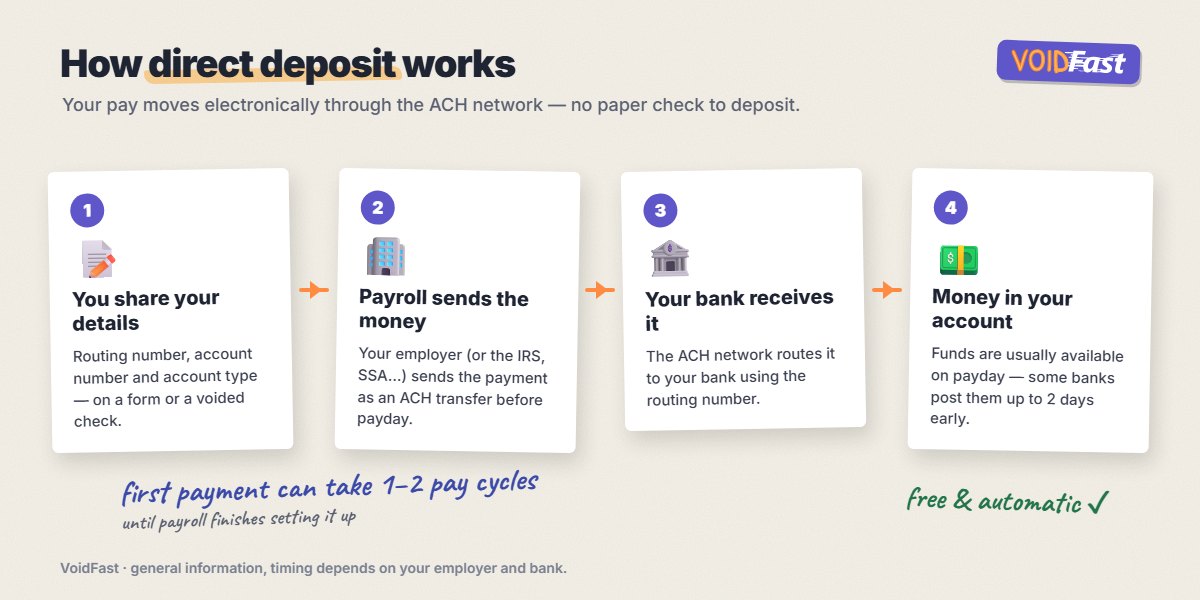
- You share your bank details — routing number, account number and whether it's checking or savings.
- Payroll sends the payment. Before payday, your employer's payroll system sends the payment as an ACH transfer.
- The ACH network routes it to your bank using the routing number.
- The money lands in your account — usually on payday, and some banks make it available up to two days early.
Payroll uses the ACH routing number, which isn't always the same as the wire routing number. See ACH vs wire routing number if your bank shows two.
What you need to set up direct deposit
- Your bank's routing number — 9 digits that identify the bank. It's on the bottom left of your checks; see where is the routing number on a check.
- Your account number — the number of your own account.
- The account type — checking or savings.
- Sometimes, proof of the account — a voided check, a bank-filled direct deposit form or a bank verification letter.
How to set up direct deposit
- Ask your employer how they collect bank details. It might be a paper form, a payroll portal or an HR app.
- Get your routing and account number from your bank's app, online banking or a check.
- Fill out the form — see how to fill out a direct deposit authorization form.
- Attach a voided check if asked. Here's how to void a check. No checks? Generate a voided check online with VoidFast for banks like Bank of America or Capital One — or browse all banks.
- Check your first payday. If the deposit doesn't arrive, ask payroll whether you got a paper check this time while the setup finishes.
Not sure what your employer will accept? Voided check for direct deposit covers the options.
How long does direct deposit take?
Setting it up usually takes one or two pay cycles, because payroll has to add your details (and some systems send a small test payment first). After that, each payment usually arrives on payday. The full timeline, and why a deposit can be late, is in how long does direct deposit take.
Pros and cons of direct deposit
| Pros | Cons |
|---|---|
| Money arrives automatically — no trip to the bank | You need a bank account (or a prepaid card that accepts direct deposit) |
| Usually faster than depositing a paper check | The first payment can take one or two pay cycles to set up |
| No lost or stolen paychecks | A wrong routing or account number can delay your pay |
| Usually free for you | Changing banks means updating every payer |
| Some banks give early access to your pay | Payment timing depends on your employer's payroll schedule |
Can you split direct deposit between accounts?
Often, yes. Many employers let you send part of each paycheck to one account and the rest to another — for example a fixed amount to savings. Ask payroll whether they allow split deposits and how many accounts you can add.
Is direct deposit safe?
Direct deposit is generally safer than a paper paycheck: there's nothing to lose, steal or forge, and the payment goes straight to your account. The main risk is a scam where someone tries to change your direct deposit details. Only share your bank details through your employer's official form or portal, and tell payroll right away if you get an unexpected "confirm your bank details" email.
Frequently asked questions
What is direct deposit?
An electronic payment sent straight into your bank account, usually through the ACH network — for example your paycheck, a tax refund or government benefits.
What do I need for direct deposit?
Your bank's routing number, your account number and the account type (checking or savings). Some employers also ask for a voided check or a direct deposit form.
Do I need a voided check for direct deposit?
Not always. Many employers accept a direct deposit form or a bank letter instead. If they do ask for one and you don't have checks, you can generate a voided check online.
How long does it take for direct deposit to start?
Usually one or two pay cycles. Until then, you may get a paper check.
Is direct deposit free?
For employees, direct deposit is almost always free.
Can I get direct deposit without a bank account?
Some prepaid cards and payment apps give you a routing and account number that can receive direct deposit. Check with the card or app provider.