Bank Verification Letter: What It Is and How to Get One
Your employer, landlord or a payment platform asked for a "bank verification letter" — or a voided check or bank letter. If you've never requested one, it sounds more complicated than it is. This guide explains what the letter contains, how to get one from your bank and when it can replace a voided check.
Quick answer: a bank verification letter is an official letter from your bank confirming that you have an account there. It usually shows your name, account type, routing number and account number, and is signed or stamped by the bank. You can request one at a branch, by phone, or in some banks' online banking.
What is a bank verification letter?
It's a document on your bank's letterhead that confirms an account exists, who owns it, and that it's open. Companies use it to make sure they're sending money to — or taking money from — the right account. It goes by several names: bank letter, account verification letter, bank confirmation letter or direct deposit letter.
What does a bank verification letter include?
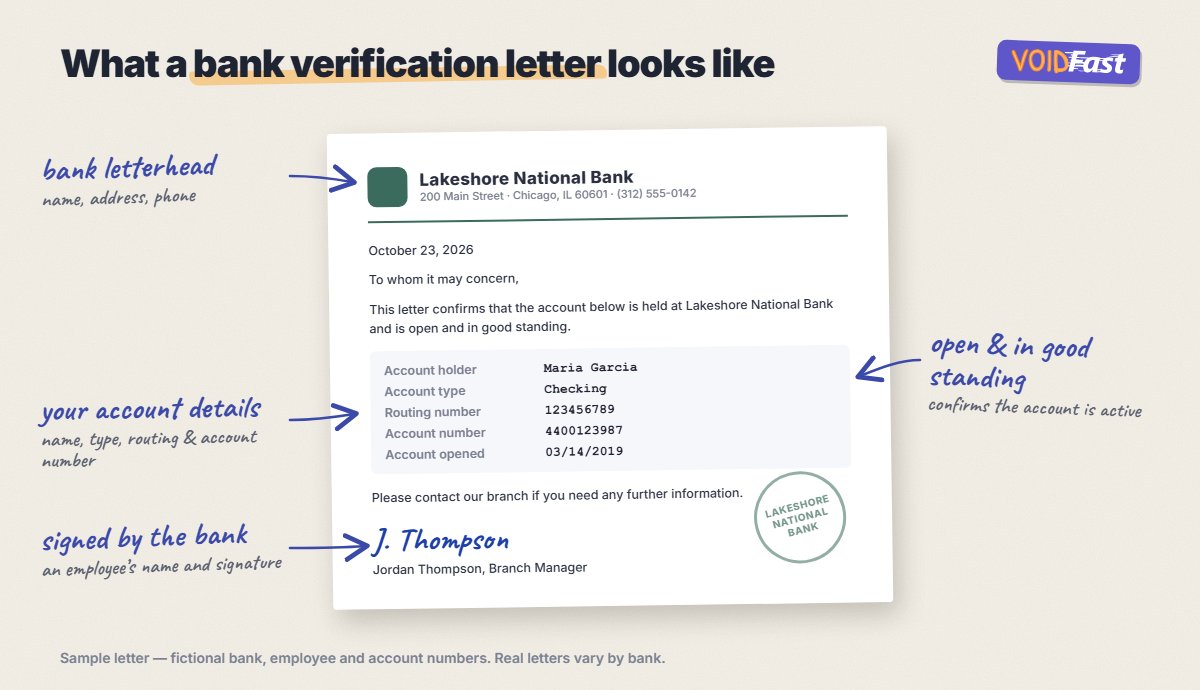
- Bank letterhead — the bank's name, address and phone number.
- Account holder name — exactly as it appears on the account.
- Account type — checking or savings.
- Routing number and account number — sometimes partly masked, so check that the company accepts that.
- Account status — that the account is open and in good standing, sometimes with the opening date.
- A signature or stamp — from a bank employee, with the date.
Some letters also include an average balance — useful for landlords or visa applications, but usually not needed for direct deposit.
When do you need a bank verification letter?
- Direct deposit — many employers accept it instead of a voided check.
- Renting an apartment — some landlords want proof of an active account.
- Getting paid by a platform or client — marketplaces and payment processors sometimes ask for it.
- Business accounts and vendors — to set up ACH payments between companies.
- Visas, loans and other applications — as proof of banking relationship or funds.
How to get a bank verification letter
- Check online banking first. Some banks let you download an account verification letter or a direct deposit form instantly.
- Visit a branch. Ask a banker for a bank verification letter for your account; bring a photo ID. Many branches can print it the same day.
- Call customer service. Some banks will mail or email the letter after verifying your identity.
- Say what it's for. Tell the bank whether you need the routing and account number on it (for direct deposit) or a balance (for a landlord or application).
Many banks provide the letter free of charge, but policies vary — ask before you request it.
Bank verification letter vs voided check
Both give a company your routing and account number. The difference:
- A voided check is quick to make if you have checks — just write "VOID" across one. See how to void a check.
- A bank letter comes from the bank itself, so it also confirms the account is open. It can take longer to get, especially if your bank is online-only.
If a form asks for "a voided check or bank letter," either one is fine. For more alternatives, see our guide on voided checks for direct deposit.
Can't get a letter quickly?
If you need to send your account details today and your bank can't issue a letter in time, you have options: download a direct deposit form from your online banking, get a counter check at a branch, or generate a voided check online with VoidFast from your routing and account number. See all the options in how to get a voided check.
Frequently asked questions
What is a bank verification letter?
An official letter from your bank confirming that you hold an account there, usually with your name, account type, routing number and account number, signed or stamped by the bank.
How long does it take to get a bank verification letter?
Often the same day at a branch, or instantly if your bank offers it in online banking. By mail it can take several days.
Is a bank verification letter free?
Many banks provide it at no cost, but some may charge a small fee. Ask your bank before requesting one.
Can I use a bank letter instead of a voided check for direct deposit?
Usually, yes. Most employers accept a bank letter with your name, routing number and account number.
Can I write my own bank verification letter?
No. The letter must come from your bank to be valid. If you need proof of your account details quickly, use a direct deposit form from your bank or a voided check instead.
What's the difference between a bank letter and a bank statement?
A statement lists your transactions for a period; a verification letter just confirms the account and its details. Some companies accept either — ask which one they need.