Voided Check for Direct Deposit: Do You Need One (and What to Use Instead)?
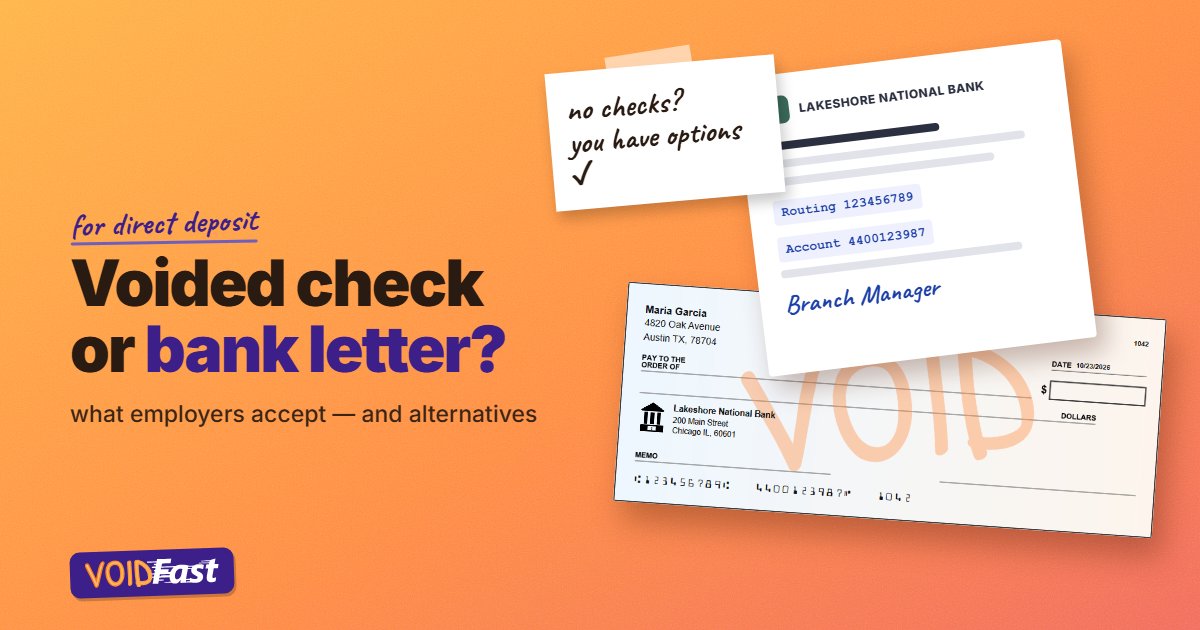
Starting a new job usually comes with a stack of paperwork, and the direct deposit form often says: "attach a voided check." If you don't have a checkbook — or you're not sure why your employer needs it — this guide explains what the voided check is for, how to send it, and what you can give instead.
Quick answer: employers ask for a voided check for direct deposit because it shows your bank's routing number and your account number in a format that's hard to get wrong. You don't always need an actual check — most employers also accept a bank letter or a direct deposit form from your bank. If they require a check and you have none, you can get a counter check from your bank or generate a voided check online.
Why do employers ask for a voided check for direct deposit?
To pay you by direct deposit, your employer's payroll system needs two numbers: your bank's routing number and your account number. A typo in either one sends your paycheck to the wrong place or gets it rejected. A voided check solves that — the numbers are printed by your bank, so payroll can copy them exactly.
It also proves that the account is yours: your name is printed on the check, which helps payroll match the account to you.
Do you need a voided check for direct deposit?
Not always. A voided check is just the most common way to share your account details. Many employers and payroll providers accept other documents too, and some only ask you to type the numbers into an online portal. Check your employer's direct deposit form or ask HR what they accept.
What you can use instead of a voided check
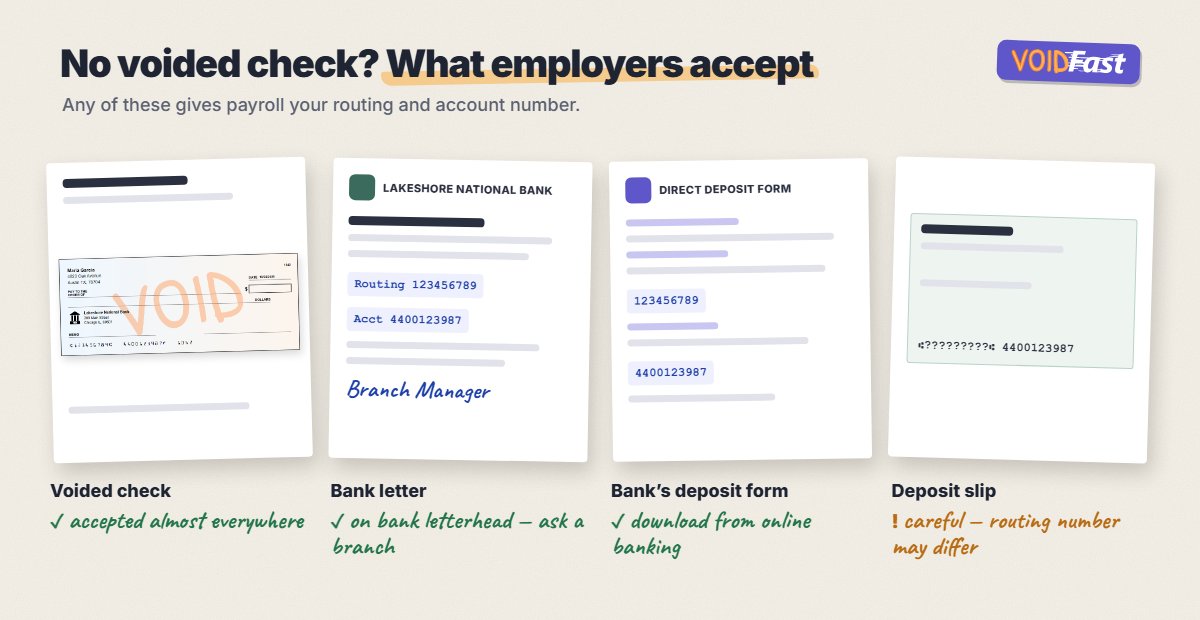
1. A bank letter
A letter from your bank on official letterhead, with your name, routing number and account number. You can usually request one at a branch, and some banks let you download one from online banking. That's why so many forms say "attach a voided check or bank letter."
2. A direct deposit form from your bank
Many banks offer a pre-filled direct deposit form in online banking or the mobile app, often under account details or account services. It already contains your routing and account numbers, and you can download it as a PDF. Learn more in our guide to the direct deposit authorization form.
3. A deposit slip — with care
Some employers accept a deposit slip, but be careful: the routing number printed on a deposit slip can be different from the one your bank uses for direct deposit and ACH payments. Always confirm the routing number with your bank before using a deposit slip.
4. A voided check you create online
If your employer specifically wants a voided check and you don't have a checkbook, you can generate a voided check online with VoidFast from your bank, routing number and account number. You get a properly formatted voided check as a PDF in about a minute, ready to print or upload.
How to send a voided check for direct deposit
- Void the check correctly. Write "VOID" in large letters across the front, without covering the numbers at the bottom, and don't sign it. See how to void a check step by step.
- Follow your employer's instructions. Staple or tape the check to the direct deposit form if you're handing in paper, or upload a clear photo or PDF if your employer uses an HR or payroll portal.
- Use a secure channel. Send it only through your employer's official system or to a known HR address — not to someone who contacted you unexpectedly.
- Double-check the numbers. Compare the routing and account numbers with your banking app before you submit.
- Watch your first paycheck. Direct deposit can take a pay cycle or two to start, so you may get a paper check or pay card first. Ask HR when it will take effect.
What does a voided check for direct deposit look like?
It's a normal check from your checkbook with "VOID" written across the front. Nothing else is filled in — no date, payee, amount or signature. The routing number, account number and check number along the bottom must be clearly readable. You can see real-format examples in what is a voided check.
Don't have a voided check? Your options
- Ask if a bank letter or bank form is accepted. This is the fastest free option for most people.
- Get a counter check at your bank. A branch can usually print one, sometimes for a small fee.
- Create a voided check online. Useful when you need an actual check today and have no checkbook. Start from your bank's page, for example Bank of America, Capital One or PNC Bank.
All the options are compared in our guide on how to get a voided check.
Frequently asked questions
Do I need a voided check for direct deposit?
Not always. Many employers accept a bank letter, a direct deposit form from your bank, or the numbers typed into a payroll portal. A voided check is just the most common option.
Is a bank letter as good as a voided check?
For most employers, yes. A bank letter on official letterhead with your name, routing number and account number gives payroll the same information.
Can I send a picture of a voided check for direct deposit?
Usually, yes. Most HR and payroll systems accept a clear photo, scan or PDF. Make sure the numbers at the bottom are sharp and readable.
Can I use a check from a savings account?
Savings accounts usually don't come with checks. If you want your pay deposited to savings, ask your bank for a bank letter or direct deposit form that shows the savings account number.
Is it safe to give my employer a voided check?
Yes, as long as you send it through your employer's official channels. A voided check can't be cashed, but it shows your account details, so don't share it with anyone you don't know.
How long does direct deposit take to start?
It depends on your employer's payroll schedule. It often starts within one or two pay periods after you submit your details. Your employer may send a small test transaction first.