What Is a Voided Check? (Meaning, Examples and Uses)
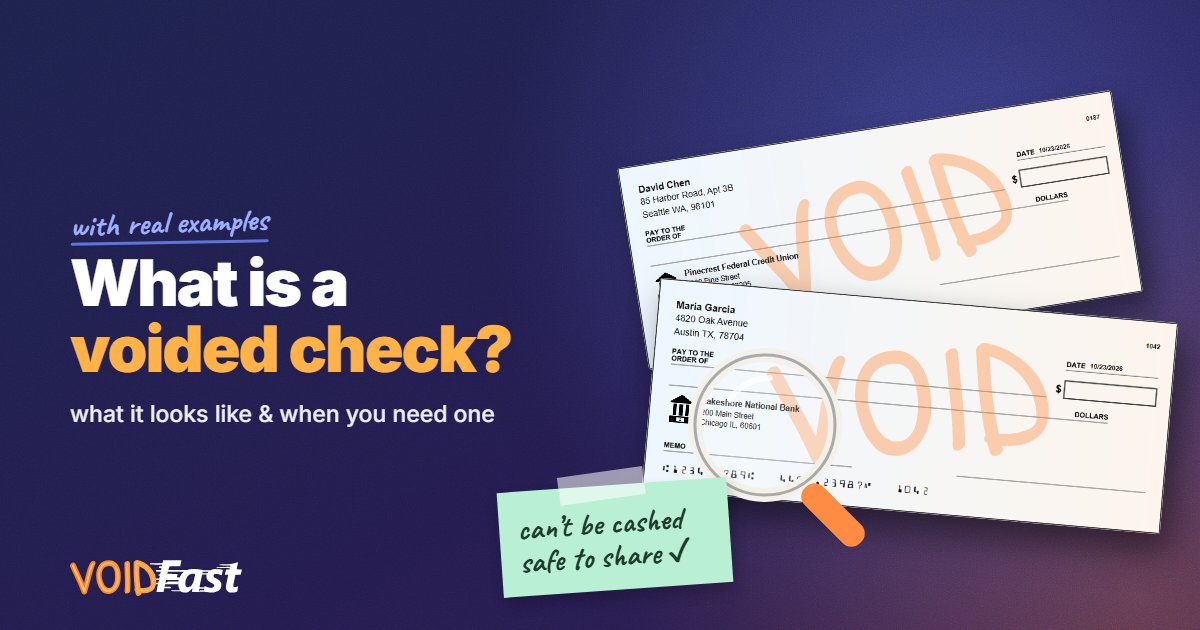
Forms for direct deposit, rent or insurance payments often say "please attach a voided check." If you're not sure what that means — or what one should look like — this guide explains it in plain terms, with real-format examples.
Quick answer: a voided check is a check with the word "VOID" written across the front, so it can't be cashed or used for a payment. It still shows your bank's routing number and your account number, which is why employers and companies ask for one to set up direct deposit or automatic payments.
What does a voided check look like?
A voided check looks like a normal blank check from your checkbook, with "VOID" written in large letters across the front. Nothing else is filled in — no date, no payee, no amount and no signature. Here are two examples:
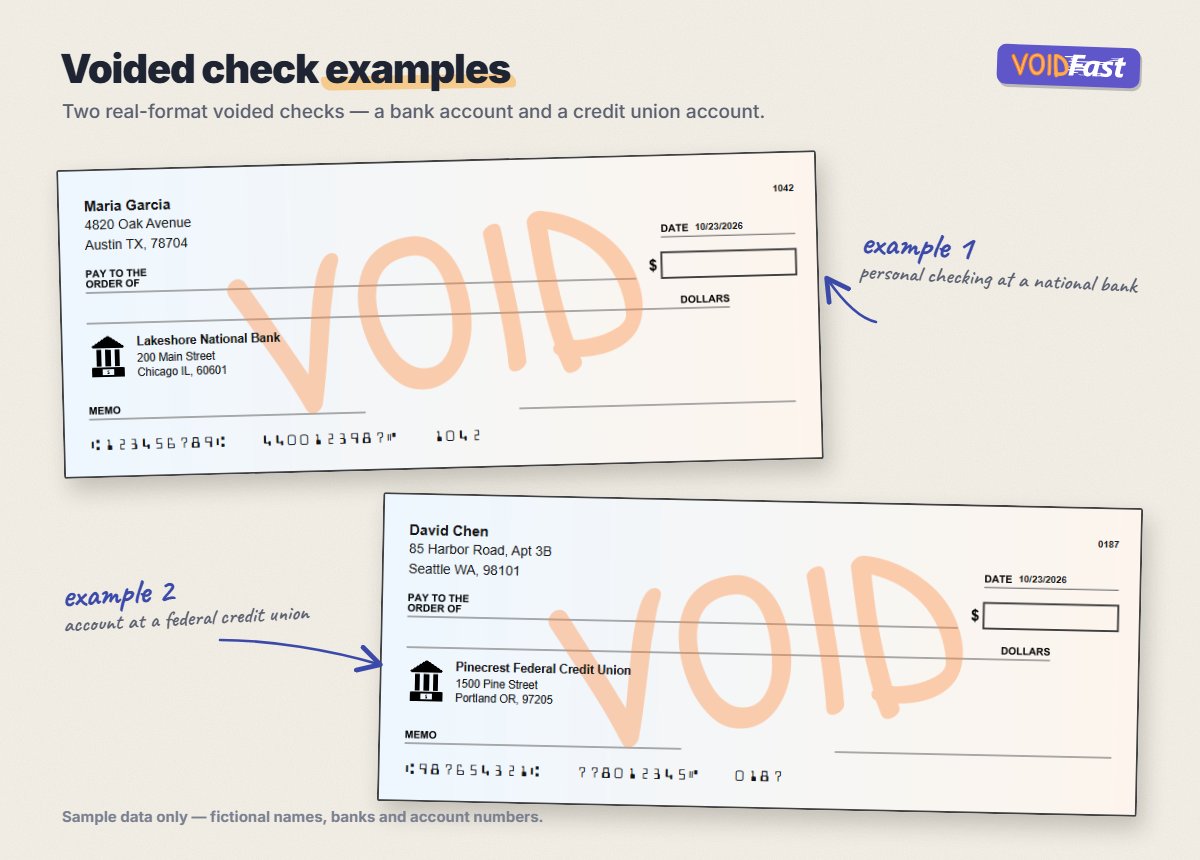
Every voided check, whether it comes from a big bank or a small credit union, has the same parts: your name and address in the top left, your bank's name, and a line of numbers along the bottom edge.
What information is on a voided check?
- Routing number — the 9-digit number at the bottom left that identifies your bank.
- Account number — the number in the middle of the bottom line that identifies your account.
- Check number — the last group of digits, which matches the number in the top right corner.
- Your name and address — so the company can match the account to you.
- Your bank's name — and often its address.
For a labeled diagram of each part, see our guide on how to get a voided check.
What is a voided check used for?
A voided check gives a company your exact account details in a format that's hard to get wrong. It's most often used for:
- Direct deposit — so your employer can send your paycheck straight to your bank account.
- Automatic payments (ACH) — rent, insurance, loan payments, utilities or memberships charged directly from your account.
- Government payments — benefits, pensions or tax refunds.
- Business payments — when clients, marketplaces or vendors pay you by bank transfer.
What is a voided check for direct deposit?
For direct deposit, a voided check is simply proof of which account your paycheck should go to. Your employer or payroll provider copies the routing and account numbers from it into their payroll system. The check itself is never deposited or cashed — that's exactly why it's marked VOID.
Many employers also accept a direct deposit form from your bank or a bank letter instead. If you're asked specifically for a voided check, any check from the correct account will do, as long as the numbers are readable.
Voided check vs. blank check vs. cancelled check
These three terms are easy to mix up, but they mean very different things:
| Voided check | Blank check | Cancelled check | |
|---|---|---|---|
| What it is | A check marked "VOID" so it can't be used | An unused check, nothing written on it | A check that has already been paid by the bank |
| Can it be cashed? | No | Yes — if someone fills it in and signs it | No, it's already been processed |
| Safe to share? | Yes, with companies that ask for it | No — never hand out a blank check | It's a payment record, not for sharing |
| Used for | Direct deposit and automatic payments | Writing a payment | Proof that a payment was made |
So a voided check is not the same as a blank check: a blank check can still be used to pay someone, while a voided check can't.
What is a "copy of a voided check"?
When a form asks for a copy of a voided check, it means a photo, scan or PDF of it instead of the paper original. Most HR portals and payroll systems accept an upload. Make sure the whole check is visible and the numbers at the bottom are sharp and readable.
Can someone misuse a voided check?
A voided check itself can't be cashed. But it does show your routing and account numbers, and in the wrong hands those can be used to attempt unauthorized electronic payments. So:
- Give it only to employers and companies you actually work with, through their official channels.
- Be careful with unexpected requests for a voided check.
- Shred extra paper copies instead of throwing them away.
- Review your bank statements and report anything you don't recognize.
How to get a voided check
If you have a checkbook, you can make one yourself in a minute — see how to void a check step by step. No checkbook? You can ask your bank for a counter check or a bank letter, download a direct deposit form from your online banking, or create a voided check online with VoidFast. You can also start from your bank's page, such as Bank of America, Capital One or Truist.
Frequently asked questions
What does "VOID" on a check mean?
It means the check has been cancelled by its owner and can't be used for a payment. Banks won't cash or deposit a check marked VOID.
Is a voided check the same as a blank check?
No. A blank check is unused and could still be filled in and cashed. A voided check has "VOID" written across it, so it can't be used — it only shows your account details.
Can a voided check be cashed?
No. A check clearly marked VOID won't be accepted by a bank for deposit or cashing.
Can I send a picture of a voided check?
Usually, yes. Most employers and payroll systems accept a clear photo, scan or PDF of a voided check. Ask if you're not sure.
Does the voided check have to be from my own account?
Yes. It must show the account where you want to receive payments — or the account payments should be taken from. A check from someone else's account won't work.
What if I don't have a voided check?
Ask whether a direct deposit form or bank letter is accepted instead. If a check is required, get a counter check from your bank or generate a voided check online.