What Is an Overdraft Fee? (How It Works and How to Avoid It)
You buy something for $60 with $40 in your account — and the purchase goes through. A day later, your balance is even lower than you expected. That's an overdraft fee. Here's how overdrafts work, when banks can charge for them, and simple ways to avoid paying one.
Quick answer: an overdraft fee is what a bank charges when it pays a transaction even though you don't have enough money in your account, leaving you with a negative balance. Fees vary by bank — the CFPB has described typical overdraft fees as about $35, while some banks charge less or nothing at all. For ATM withdrawals and one-time debit card purchases, banks can't charge an overdraft fee unless you've opted in; without opt-in, those transactions are usually just declined.
How an overdraft works
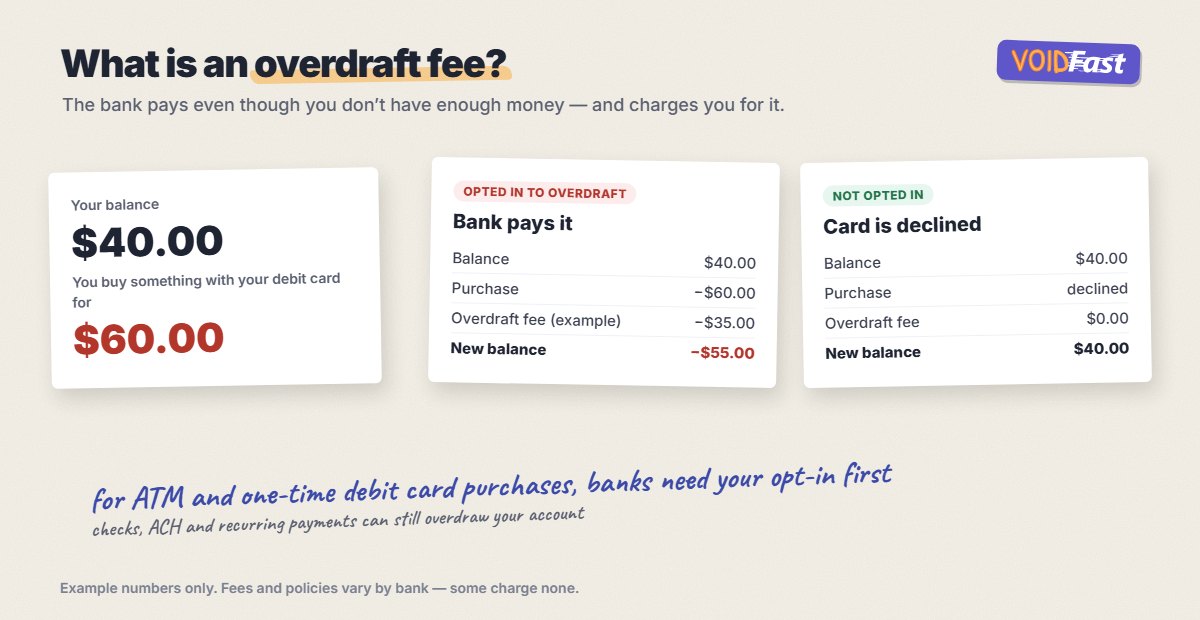
When a payment comes in and your balance is too low, your bank decides whether to:
- Pay it — your balance goes negative, and the bank may charge an overdraft fee. You need to bring the account back above zero.
- Decline or return it — the payment doesn't go through. For returned checks and ACH payments, some banks charge a non-sufficient funds (NSF) fee, though most large banks have dropped NSF fees. See what is a bounced check.
The opt-in rule for debit cards and ATMs
Under federal Regulation E, a bank can't charge an overdraft fee on ATM withdrawals or one-time debit card purchases unless you've agreed to its overdraft service ("opted in"). If you haven't opted in, the bank will usually decline those transactions instead.
The opt-in rule doesn't cover checks, ACH payments (like autopay — see what is an ACH transfer and what is an electronic check) or recurring debit card payments. Those can still overdraw your account under your bank's overdraft policy.
You can usually check or change your opt-in choice in your bank's app, online or by calling your bank.
How much is an overdraft fee?
It depends on your bank. The CFPB has described typical overdraft fees as about $35. Many banks have cut back in recent years — some have lowered fees, added grace periods, stopped charging for small overdrafts, or dropped overdraft fees altogether. Some limit how many fees they charge per day. Check your bank's fee schedule to see exactly what you'd pay.
A CFPB rule that would have limited overdraft fees at large banks was repealed by Congress in 2025 before it took effect, so fees are set by each bank's own policy.
How to avoid overdraft fees
- Don't opt in to overdraft coverage for debit cards and ATMs — or opt out if you did.
- Turn on low-balance alerts in your bank's app.
- Link a savings account for overdraft protection transfers. There may be a smaller fee, or none.
- Watch pending transactions and autopay dates, especially before payday.
- Choose an account without overdraft fees — many banks and credit unions offer one.
- Get paid sooner with direct deposit, so your paycheck lands in your account on payday. See what is direct deposit.
What to do if you're charged an overdraft fee
- Bring your balance back above zero as soon as you can — some banks waive the fee if you do it quickly.
- Ask your bank to waive it. Many will, especially for a first fee.
- Review your opt-in setting and alerts to avoid the next one.
Overdraft vs checking and savings
Overdrafts happen in checking accounts, where your everyday payments come out. Keeping a buffer in savings — and linking it — is one of the easiest protections. See checking vs savings account. Switching to a new bank to avoid fees? Your employer will need your new account details for direct deposit — and if they want a voided check, you can generate a voided check online with VoidFast, for example for TD Bank or Capital One.
Frequently asked questions
What is an overdraft fee?
A fee your bank charges when it pays a transaction that you don't have enough money to cover, leaving a negative balance.
How much is an overdraft fee?
It varies by bank. The CFPB has described typical fees as about $35; some banks charge less or nothing.
Can a bank charge an overdraft fee without my permission?
Not for ATM withdrawals or one-time debit card purchases — you must opt in first. Checks, ACH and recurring payments are not covered by that rule.
What happens if I don't opt in to overdraft?
ATM withdrawals and one-time debit card purchases that would overdraw your account are usually declined, with no overdraft fee.
What is the difference between an overdraft fee and an NSF fee?
An overdraft fee is charged when the bank pays the transaction; an NSF fee is charged when it returns the transaction unpaid. Many large banks no longer charge NSF fees.
Can I get an overdraft fee refunded?
Often — ask your bank, especially if it's your first fee or you fixed the balance quickly.