Checking vs Savings Account: What's the Difference and Which to Use?
Most banks offer both, and a direct deposit form usually asks you to tick one: checking or savings. Here's how a checking account and a savings account differ, which one to use for your paycheck, and why most people end up with both.
Quick answer: a checking account is for everyday money — paychecks, bills, debit card purchases and checks — and usually pays little or no interest. A savings account is for money you want to keep: it earns interest but is less convenient to spend from, and some banks limit how many withdrawals you can make each month. Most people get paid into checking and move part of it to savings.
Checking vs savings at a glance
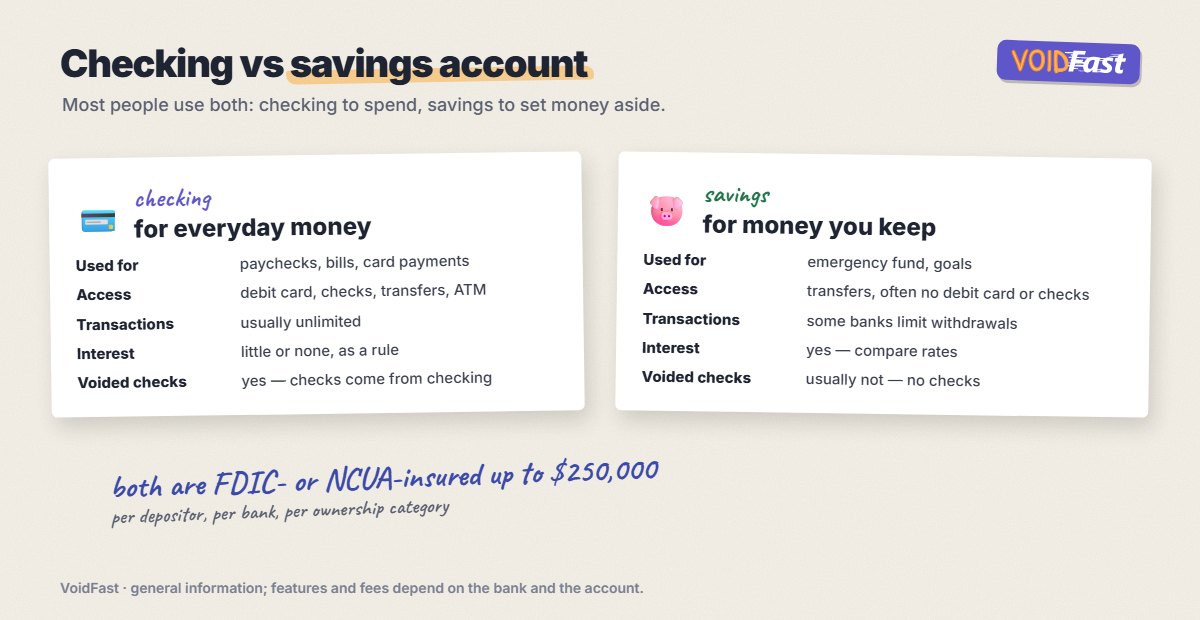
| Checking account | Savings account | |
|---|---|---|
| Main purpose | Everyday spending and bills | Setting money aside |
| Debit card | Usually yes | Often no |
| Checks | Yes | Usually no |
| Transactions | Usually unlimited | Some banks limit withdrawals |
| Interest | Little or none, as a rule | Yes — rates vary a lot |
| Insurance | Both covered by FDIC (banks) or NCUA (credit unions) up to $250,000 per depositor, per institution, per ownership category | |
What is a checking account?
A checking account is built for moving money in and out. Your paycheck lands there, you pay bills and card purchases from it, and you can write checks. Because you use it all the time, it usually has no limit on transactions — but it typically pays little or no interest.
What is a savings account?
A savings account is for money you don't plan to spend right away, like an emergency fund. It earns interest, and keeping it separate makes it less tempting to spend. You usually move money in and out by transfer rather than with a card or checks.
For years, a federal rule (Regulation D) limited savings accounts to six certain withdrawals or transfers a month. The Federal Reserve suspended that limit in 2020, but many banks still set their own limits and may charge a fee or convert the account if you go over. Check your account's terms.
Which account should I use for direct deposit?
Most people choose checking for their paycheck, because that's where bills and card payments come from. You can also send pay to savings, and many employers let you split it — for example a fixed amount to savings and the rest to checking.
Whatever you choose, tick the right account type on the form. The routing number is usually the same for checking and savings at the same bank, but the account numbers are different. If the account number and the account type don't match, the deposit can be rejected or delayed. More in what is direct deposit.
Can I get a voided check for a savings account?
Usually not — checks come from checking accounts. If your employer asks for a voided check and you want your pay in savings, ask whether they'll accept a direct deposit form or a bank verification letter instead. For a checking account without a checkbook, you can generate a voided check online with VoidFast — for example for Capital One or Citibank. Or void one of your own checks: how to void a check.
Should I have both?
For most people, yes. A common setup is: pay goes into checking, bills and spending come out of checking, and a fixed amount moves to savings every payday. Many banks let you link the two, which makes transfers easy — and some can use savings to cover a checking shortfall.
How to tell which account you have
- Your bank's app or online banking shows the account name and type.
- If you have checks for it, it's a checking account.
- Your statement shows the account type at the top.
Need the routing and account number too? See where is the routing number on a check — and note that it isn't on your debit card: is the routing number on a debit card?
Frequently asked questions
What is the difference between a checking and a savings account?
Checking is for everyday spending, with a debit card, checks and usually unlimited transactions but little interest. Savings is for money you keep, with interest but fewer ways to spend from it.
Is it better to have direct deposit go to checking or savings?
Most people use checking, since bills come out of it. Splitting your pay between checking and savings is a good way to save automatically.
Do checking and savings accounts have the same routing number?
Usually, at the same bank, yes — but the account numbers are different. Always use the numbers your bank shows for that specific account.
Is there a limit on savings account withdrawals?
The federal six-withdrawal rule was suspended in 2020, but many banks still set their own limits. Check your account terms.
Are checking and savings accounts insured?
Yes, at FDIC-insured banks and NCUA-insured credit unions, up to $250,000 per depositor, per institution, per ownership category.
Can I write checks from a savings account?
Usually not. Checks are tied to checking accounts.