Cashier's Check vs Money Order vs Certified Check: Which One to Use?
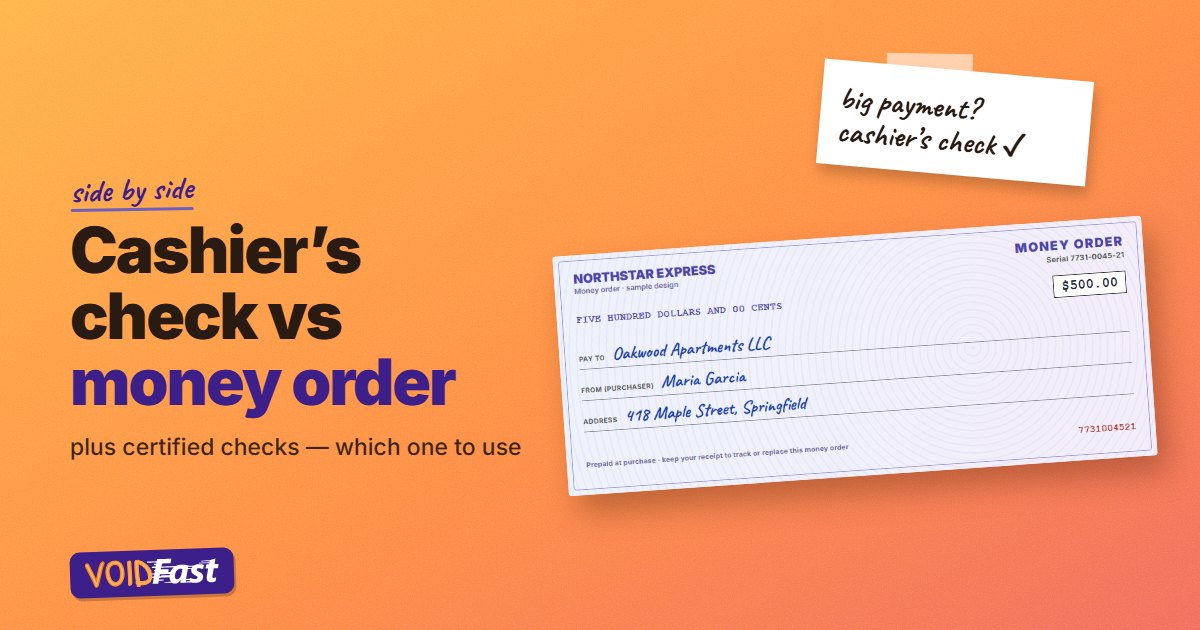
When someone won't take a personal check, they usually ask for a cashier's check or a money order instead. Both are "guaranteed" payments, but they work differently, cost different amounts and have different limits. Here's how a cashier's check, a money order and a certified check compare — and which one to pick for your payment.
Quick answer: use a cashier's check for large payments (rent deposits, cars, home closings) — it's drawn on the bank's own funds and has no set maximum. Use a money order for smaller payments, especially if you don't have a bank account — it's prepaid, sold at post offices and stores, and often capped at $1,000. A certified check is your own check that the bank guarantees, but fewer banks offer it today.
Cashier's check vs money order vs certified check at a glance
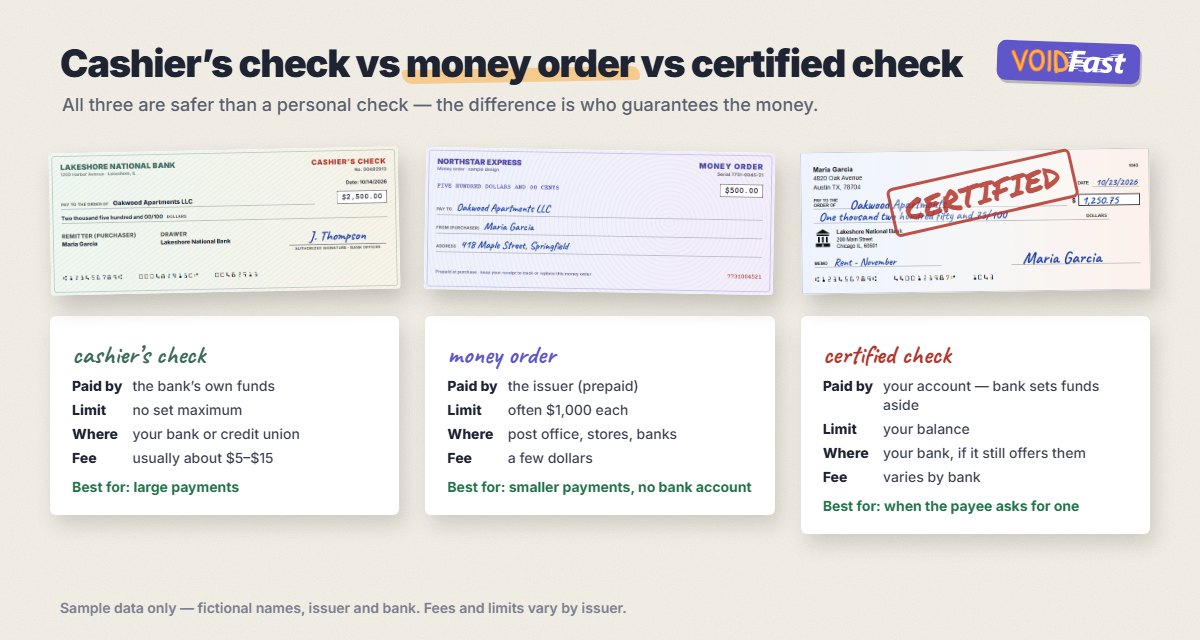
| Cashier's check | Money order | Certified check | |
|---|---|---|---|
| Who guarantees it | The bank (its own funds) | The issuer (you prepay) | The bank (funds set aside in your account) |
| Where to get it | Your bank or credit union | Post office, stores, check cashers, some banks | Your bank, if it still offers them |
| Bank account needed | Usually yes | No | Yes |
| Maximum amount | No set maximum | Often $1,000 per money order | Your available balance |
| Typical fee | About $5–$15 | A few dollars | Varies by bank |
| Best for | Large payments | Small payments, no bank account | When the payee specifically asks for it |
What is a cashier's check?
A cashier's check is written by your bank from the bank's own money. You pay the bank first, a bank officer signs the check, and the payee can be confident it won't bounce — as long as it's genuine. It's the standard choice for big payments because there's no fixed limit. More details in what is a cashier's check.
What is a money order?
A money order is a prepaid paper payment. You pay the amount plus a small fee — in cash or with a debit card at many locations — and the issuer prints the amount on the order. You fill in the payee's name and your own details.
Money orders are sold by the U.S. Postal Service, big retailers, check-cashing stores and some banks. They're popular for rent and bills because you don't need a bank account. The catch is the limit: the Postal Service caps domestic money orders at $1,000 each, and other issuers often have similar limits, so a larger payment means buying several.
Always keep the receipt (the stub). You'll need the serial number to track the money order or to get a replacement if it's lost.
What is a certified check?
A certified check is a personal check that your bank "certifies": it checks your signature, confirms the money is in your account, sets that amount aside and stamps the check as certified. The money is guaranteed, but it still comes from your account, not the bank's.
Many banks have stopped offering certified checks and suggest a cashier's check instead. If a payee asks for "certified funds", a cashier's check is usually accepted too — ask them to be sure.
Which one should you use?
- Security deposit, down payment, car purchase, closing costs → cashier's check.
- Monthly rent or a bill under about $1,000, no bank account → money order.
- The payee asked for a certified check → ask your bank; if it doesn't offer them, ask the payee whether a cashier's check works.
- Paying someone you know, small amount → a personal check or a bank transfer is usually fine and cheaper.
Is a cashier's check safer than a money order?
For the person receiving it, both are safer than a personal check, because the money is paid up front. A cashier's check is backed by a bank, which many payees prefer for large amounts. Both can be counterfeited, though. If you receive one, verify it with the issuer using contact details from its official website, and be very careful with anyone who overpays and asks for the difference back.
Can you cancel a cashier's check or a money order?
Both are harder to cancel than a personal check. For a lost or stolen cashier's check, the bank may require a declaration of loss and a waiting period. For a money order, the issuer can usually trace it and refund or replace it if it hasn't been cashed, often for a fee and only with the receipt.
What about direct deposit?
None of these three can be used to set up direct deposit. A cashier's check and a money order don't show your account numbers, and a certified check is meant for paying someone. For direct deposit, your employer needs your routing and account number — on a voided check, a direct deposit authorization form or a bank letter. No checkbook? Generate a voided check online with VoidFast, for example for U.S. Bank or TD Bank.
Need a check from your bank today but no checkbook? A counter check may help.
Frequently asked questions
What is the difference between a money order and a cashier's check?
A cashier's check is issued by a bank from its own funds and has no set limit. A money order is prepaid, sold at post offices and stores, doesn't need a bank account and is usually capped at around $1,000.
Is a cashier's check the same as a money order?
No. Both are prepaid and safer than personal checks, but they're issued by different places and have different limits and fees.
Is a certified check the same as a cashier's check?
No. A certified check is your own check with funds guaranteed by the bank. A cashier's check is drawn on the bank's own account.
Which is cheaper, a money order or a cashier's check?
A money order is usually cheaper — often a few dollars — while a cashier's check is commonly around $5 to $15.
What is the maximum amount for a money order?
The U.S. Postal Service limits domestic money orders to $1,000 each. Other issuers set their own limits, often similar.
Can I get a cashier's check without a bank account?
Usually not at big banks. Some credit unions or banks will sell one for cash. Without an account, a money order is the easier choice.