What Is a Cashier's Check? (How to Get One, Cost and Safety)
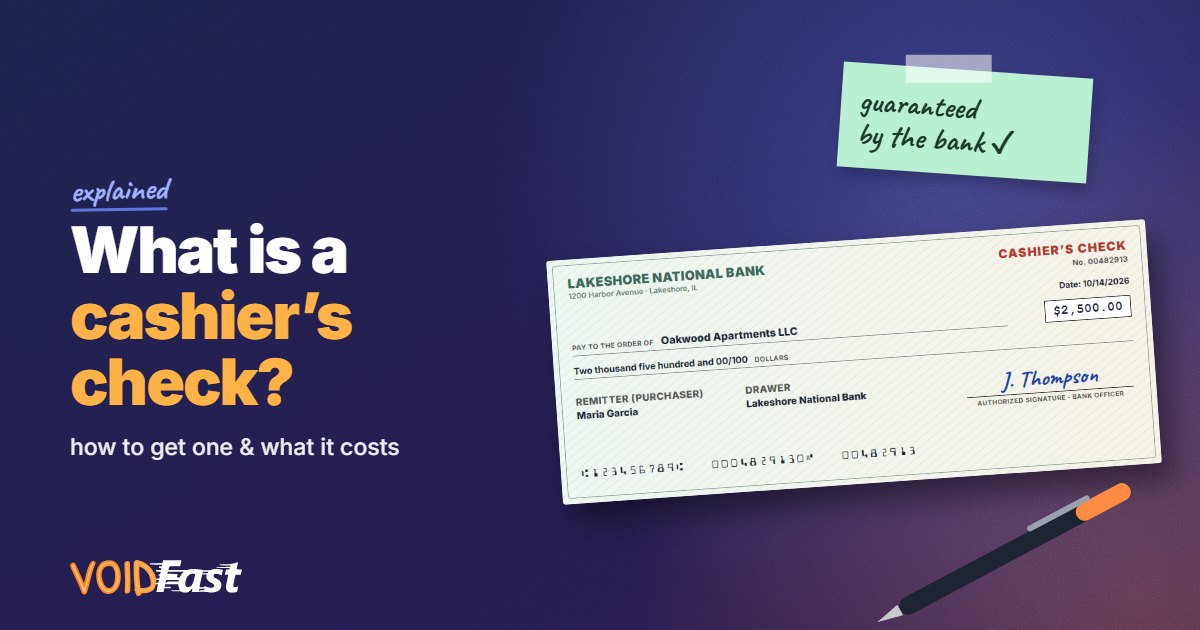
A landlord wants your security deposit by cashier's check. A car seller won't take a personal check. A closing agent asks for "certified funds". In all of these cases, a cashier's check is the usual answer. Here's what a cashier's check is, how to get one, what it costs — and how to make sure one you receive isn't fake.
Quick answer: a cashier's check is a check written by a bank from its own funds and signed by a bank employee. You pay the bank the full amount up front (plus a fee), so the person receiving it knows the money is there. You can get one at your bank or credit union, usually at a branch, with your ID and the payee's exact name.
What is a cashier's check?
With a personal check, the money comes from your account when the check is cashed — and if you don't have enough, the check bounces. With a cashier's check, the bank takes the money from your account first and then writes the check on its own account. The bank is the one paying, so the check is guaranteed as long as it's genuine.
That's why sellers, landlords and title companies ask for cashier's checks for large payments: they don't have to trust your balance, only the bank.
Parts of a cashier's check
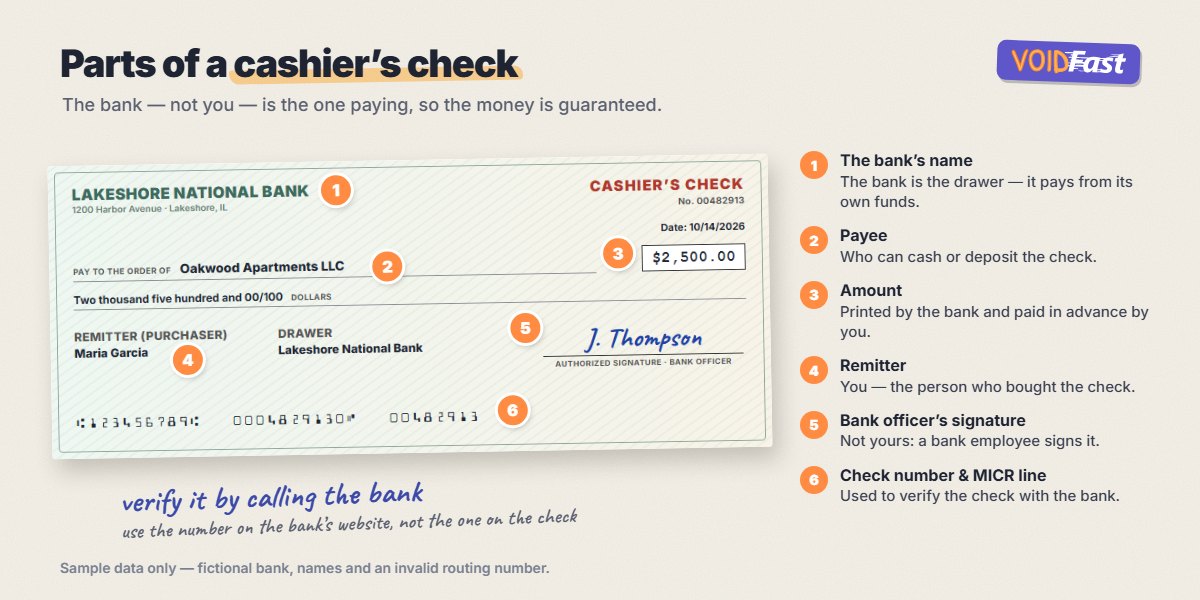
- The bank's name — the bank is the drawer, the one paying.
- Payee — the person or company the check is made out to.
- Amount — printed by the bank. You can't change it.
- Remitter — you, the person who bought the check.
- Authorized signature — signed by a bank officer, not by you.
- Check number and MICR line — the bank's routing and account numbers, used to process and verify the check.
How to get a cashier's check
- Go to your bank or credit union. Many banks issue cashier's checks only at a branch; some let you order one online or in the app and pick it up or have it mailed.
- Bring a photo ID and your debit card or account details.
- Know the exact payee name and amount. The bank prints them on the check, so a typo means buying a new one.
- Pay the amount plus the fee. The money is taken from your account (or paid in cash) right away.
- Keep the receipt. You'll need it if the check is lost or you have to cancel it.
Most banks sell cashier's checks only to their own customers. If you don't have a bank account, a money order is usually the easier option for smaller amounts.
How much does a cashier's check cost?
Fees depend on the bank and your account type. Many banks charge somewhere around $5 to $15 per check, and some premium accounts include them free. Ask your bank or look at its fee schedule before you go.
How long is a cashier's check good for?
Cashier's checks don't have a fixed expiration date by law, but some banks print a notice like "void after 90 days". Even without one, the payee should deposit it soon — an old uncashed cashier's check can eventually be turned over to the state as unclaimed property. If you're the payee, deposit it as soon as you can.
When you deposit a cashier's check, the money is usually available faster than for a personal check — often the next business day, especially when you deposit it in person to your own account.
Can you cancel a cashier's check?
Not as easily as a personal check. Because the bank has already guaranteed the payment, you generally can't just stop it. If a cashier's check is lost, stolen or destroyed, the bank may ask you to sign a declaration of loss and wait a set period (often up to 90 days) before it refunds you or issues a new one. Some banks offer an indemnity bond to speed this up, for a fee.
How to spot a fake cashier's check
Fake cashier's checks are common in online sales, rental and job scams. The usual pattern: someone "overpays" with a cashier's check and asks you to send back the difference. Days later the check turns out to be fake, and you've lost the money you sent.
- Call the issuing bank to confirm the check — but use the phone number from the bank's official website, not the one printed on the check.
- Be wary of overpayments and requests to send money back by gift cards, wire or payment apps.
- Don't spend the money just because it shows up in your account — a fake can bounce later.
- Check the details: misspellings, a missing bank address or a blurry logo are warning signs.
Cashier's check vs certified check vs counter check
These three get mixed up a lot:
- Cashier's check — drawn on the bank's money and guaranteed by the bank.
- Certified check — your own check, but the bank confirms and sets aside the funds. Fewer banks offer them today.
- Counter check — a plain check printed at the branch on your account, not guaranteed. See what is a counter check.
For a full comparison including money orders, see cashier's check vs money order vs certified check.
Can I use a cashier's check for direct deposit?
No. A cashier's check shows the bank's account numbers, not yours, so your employer can't use it to send your pay. For direct deposit you need a voided check from your own account, a direct deposit form or a bank letter. If you don't have checks, you can generate a voided check online with VoidFast — for example for Citibank or PNC. All options are in how to get a voided check.
Frequently asked questions
What is a cashier's check?
A check issued by a bank from its own funds and signed by a bank employee. You pay the bank in advance, so the payment is guaranteed.
Where can I get a cashier's check?
At your bank or credit union, usually at a branch. Most banks only sell them to account holders.
How much does a cashier's check cost?
Usually somewhere around $5 to $15, depending on the bank and your account. Some accounts include them free.
Is a cashier's check the same as cash?
Close, but not quite. It's guaranteed by the bank, so it's treated much like cash — but it can still be fake, so verify it with the issuing bank.
How long does a cashier's check take to clear?
Often by the next business day after you deposit it, which is faster than a personal check. Your bank's funds availability policy has the details.
Can I get a cashier's check without a bank account?
Some credit unions and banks will issue one if you pay in cash, but many won't. A money order is usually easier if you don't have an account.