What Is a Wire Transfer? (How It Works, How Long It Takes and What It Costs)
Buying a home, paying a large invoice or sending money abroad? You'll probably be asked to send a wire transfer. Wires are fast and secure — but once the money arrives, it's very hard to get back. Here's what a wire transfer is, how long it takes, what you need to send one, and how to avoid wire fraud.
Quick answer: a wire transfer is an electronic payment sent directly from one bank to another, one transaction at a time. Domestic wires often arrive the same business day if sent before your bank's cutoff time; international wires usually take about 1–5 business days. Banks usually charge a fee to send a wire, and some charge to receive one. Wires are generally final, so double-check the details before you send.
How a wire transfer works
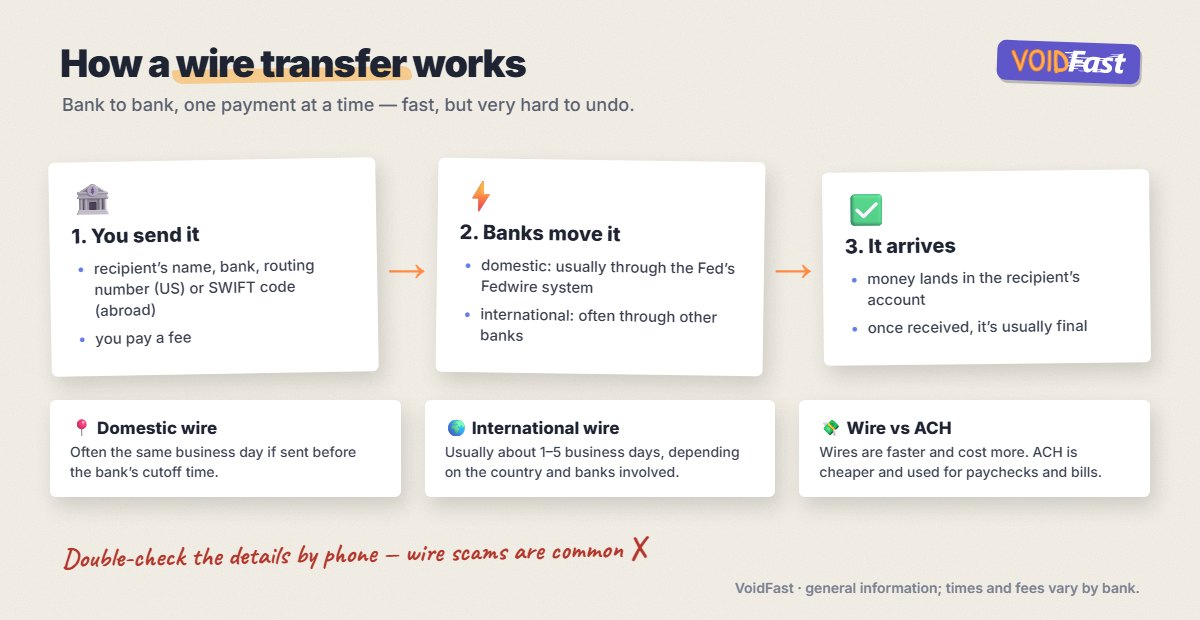
- You ask your bank to send it — in a branch, online or by phone — and give the recipient's details.
- The banks move the money. Domestic wires usually go through Fedwire, the Federal Reserve's payment system. International wires often pass through other banks on the way.
- The money arrives in the recipient's account, usually ready to use quickly.
What you need to send a wire
- The recipient's full name and address
- Their bank's name and address
- Their account number
- Domestic: the bank's routing number for wires — some banks use a different one than for ACH. See ACH vs wire routing number.
- International: the bank's SWIFT code, and often an IBAN for the account. See what is a SWIFT code.
- The amount and the reason or reference (for example, an invoice number)
How long does a wire transfer take?
- Domestic: often the same business day if sent before the bank's cutoff time; otherwise the next business day.
- International: usually about 1–5 business days, depending on the country, the currency and how many banks are involved.
Weekends and holidays don't count, and banks may hold a wire for extra security checks.
How much does a wire transfer cost?
It depends on your bank and account. Outgoing wires usually cost more than incoming ones, international wires cost more than domestic ones, and some premium accounts include free wires. For international wires, also look at the exchange rate — it can cost more than the fee itself. Check your bank's fee schedule before you send.
Wire transfer vs ACH transfer
| Wire transfer | ACH transfer | |
|---|---|---|
| Speed | Often same day | Usually 1–2 business days (same-day available) |
| Cost | Usually a fee | Usually free or low-cost |
| Typical use | Large or urgent payments, international payments | Paychecks, bills, everyday transfers |
| Reversing it | Very hard once received | Possible in some cases |
More on ACH in what is an ACH transfer.
Can you cancel a wire transfer?
Domestic wires are generally final once the money is received — contact your bank immediately if you made a mistake, but there's no guarantee. For international transfers sent by consumers, federal remittance rules usually give you 30 minutes after paying to cancel and get a full refund, as long as the money hasn't been picked up or deposited yet.
Avoid wire transfer fraud
- Verify wire instructions by phone, using a number you already know — never one from the email asking you to wire money. Fake "updated" instructions are a common scam in home purchases.
- Never wire money to someone you've only met online, or to "release" a prize, refund or inheritance.
- Be suspicious of urgency. Scammers push you to act before you can check.
Receiving a wire
To receive a domestic wire, you'll give the sender your bank's wire routing number and your account number. For everyday deposits like a paycheck, direct deposit (ACH) is more common — and your employer may ask for a voided check to set it up. No checks? You can generate a voided check online with VoidFast, for example for PNC or Citibank.
Frequently asked questions
What is a wire transfer?
An electronic bank-to-bank payment sent one transaction at a time, often used for large, urgent or international payments.
How long does a wire transfer take?
Domestic wires often arrive the same business day; international wires usually take about 1–5 business days.
Is a wire transfer safe?
The system is secure, but wires are hard to reverse, so scammers like them. Verify instructions by phone before sending.
Can a wire transfer be reversed?
Generally not once received. International consumer transfers can usually be canceled within 30 minutes of payment if the money hasn't been picked up or deposited.
What information do I need to send a wire?
The recipient's name, bank, account number, and either the wire routing number (US) or the SWIFT code (international).
Is a wire transfer the same as an ACH transfer?
No. Wires are faster and usually cost more; ACH is cheaper and used for paychecks and bills.