What Is a SWIFT Code? (Format, How to Find Yours, and vs Routing Number)
If someone abroad wants to send you money, they'll ask for your bank's SWIFT code. It's not the same as your routing number — and US accounts don't have an IBAN. Here's what a SWIFT code is, how to read one, where to find your bank's code, and when you need it.
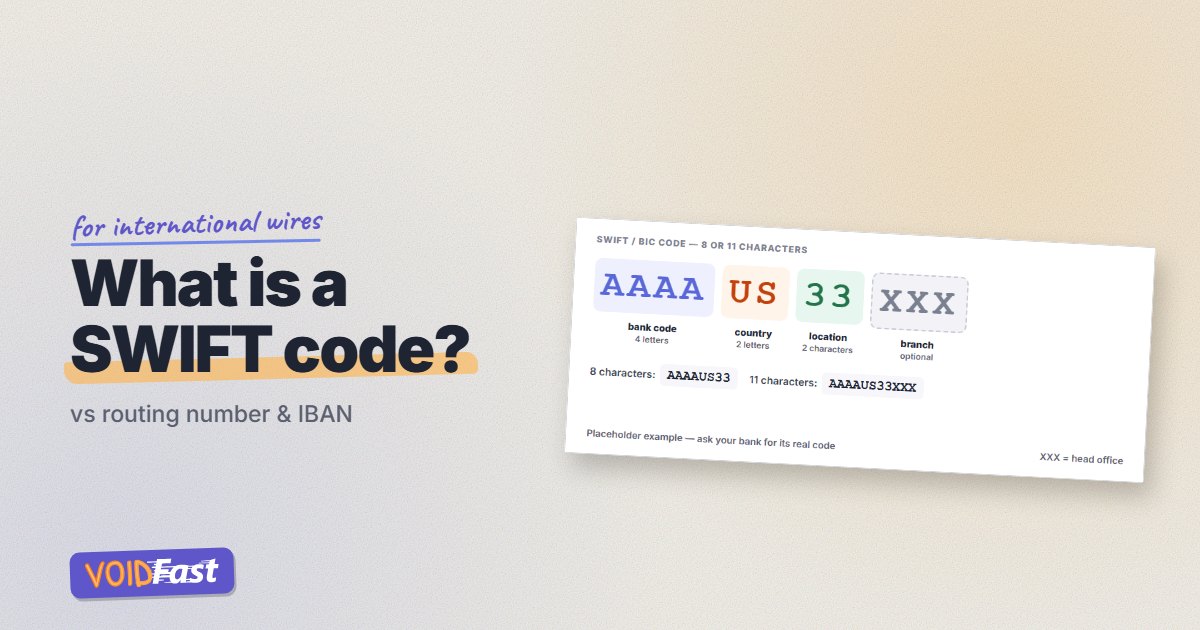
Quick answer: a SWIFT code (also called a BIC) is an 8- or 11-character code that identifies a bank for international payments. It's made of a 4-letter bank code, a 2-letter country code (US for the United States), a 2-character location code and an optional 3-character branch code. You need it for international wire transfers — not for direct deposit or transfers within the US, which use your 9-digit routing number.
SWIFT code format
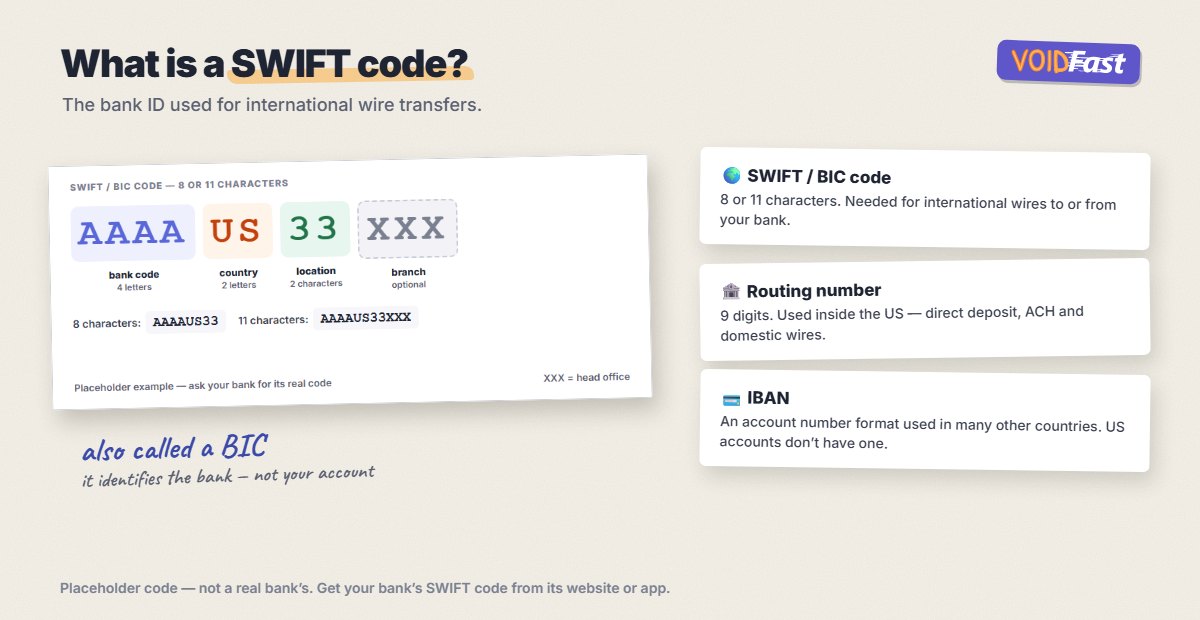
- Bank code (4 letters) — usually an abbreviation of the bank's name.
- Country code (2 letters) — "US" for banks in the United States.
- Location code (2 characters) — letters or digits for the bank's location.
- Branch code (3 characters, optional) — a specific branch or office. "XXX" means the main office. An 8-character code usually refers to the main office too.
SWIFT code vs routing number vs IBAN
| SWIFT / BIC code | Routing number | IBAN | |
|---|---|---|---|
| What it identifies | A bank (internationally) | A US bank | A specific account |
| Format | 8 or 11 letters and digits | 9 digits | Up to 34 characters |
| Used for | International wires | Direct deposit, ACH, domestic wires | Payments in countries that use IBANs |
| Do US accounts have one? | The bank usually does | Yes | No |
Your routing number is the one printed on your checks — see where is the routing number on a check. Some banks use a different routing number for domestic wires; see ACH vs wire routing number.
How to find your bank's SWIFT code
- Your bank's website or app — look for "international wire" or "receive money from abroad".
- Call your bank or ask at a branch.
- Check the incoming wire instructions your bank gives you — they list the exact details the sender needs.
Use the code your bank gives you rather than one from a random lookup site. Smaller banks and credit unions may not have their own SWIFT code and instead receive international wires through a larger partner (intermediary) bank, with special instructions.
What you give someone sending you money from abroad
- Your full name and address, exactly as on the account
- Your bank's name and address
- Your bank's SWIFT code
- Your account number
- Any intermediary bank details your bank requires
For how international wires move and what they cost, see what is a wire transfer.
Is it safe to share a SWIFT code?
Yes — a SWIFT code is public information about your bank, not your account. Your account number is more sensitive, so share it only with people and companies you trust.
Do you need a SWIFT code for direct deposit?
No. US direct deposit uses your routing number and account number. Employers often ask for a voided check because it shows both. If you don't have checks, you can generate a voided check online with VoidFast, for example for Bank of America or U.S. Bank.
Frequently asked questions
What is a SWIFT code?
An 8- or 11-character code that identifies a bank for international payments. It's also called a BIC.
Is a SWIFT code the same as a routing number?
No. A routing number is a 9-digit US bank number for domestic payments; a SWIFT code is used for international wires.
Do US banks have IBANs?
No. US accounts don't use IBANs. Someone abroad sending you money uses your bank's SWIFT code and your account number.
Where do I find my bank's SWIFT code?
On your bank's website or app (international wire instructions), or by calling your bank.
What does XXX mean in a SWIFT code?
It's the branch code for the bank's main office.
Do I need a SWIFT code to receive direct deposit?
No. Direct deposit in the US only needs your routing number and account number.