How to Write a Check With Cents (With Examples)
Writing a check for an even dollar amount is easy. But what do you do with the cents — like $84.50 or $1,005.07? The rule is simple once you see it: decimals in the box, a fraction on the words line. Here's how to write a check with cents, with examples you can copy.
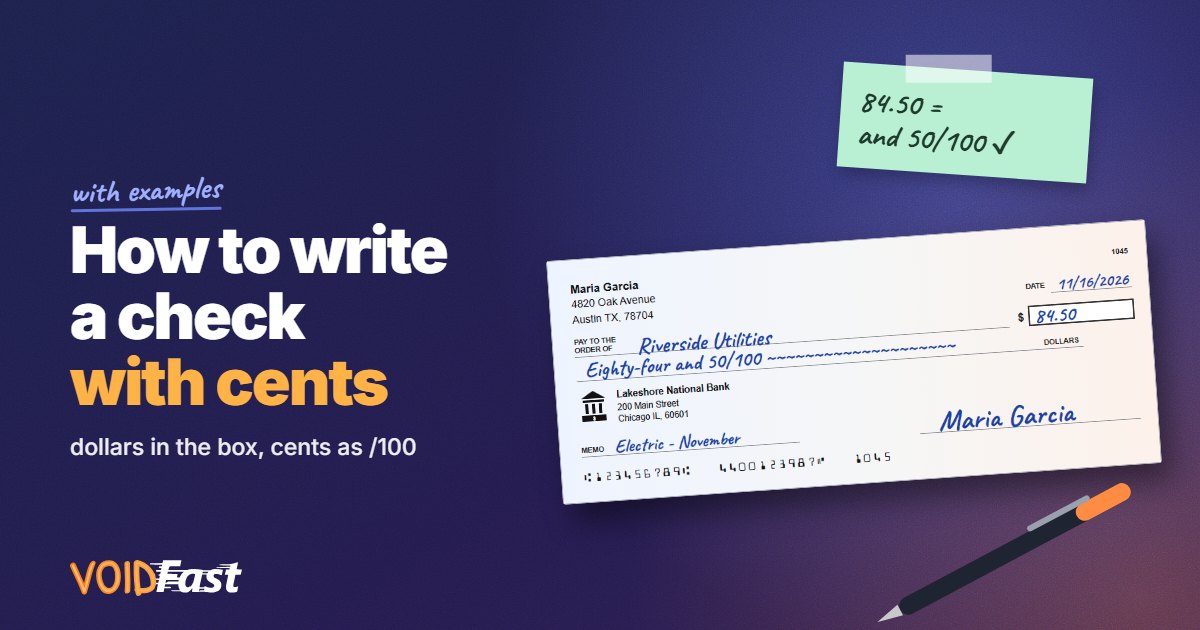
Quick answer: write the amount in the dollar box with a decimal point and two digits for cents (84.50). On the line below "Pay to the order of", write the dollars in words, then "and", then the cents as a fraction over 100: Eighty-four and 50/100. Draw a line through the empty space after it so nothing can be added. To get the exact words for any amount, use our free check amount in words converter.
Example: a check for $84.50
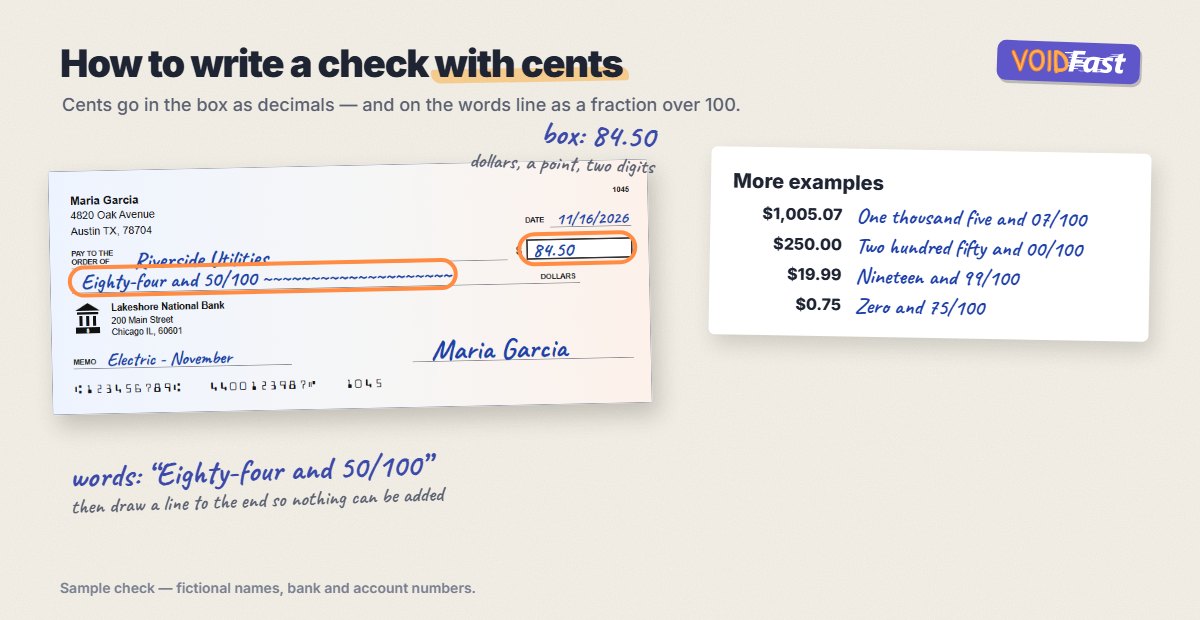
How to write the cents, step by step
- Dollar box: write the amount in numbers, starting close to the dollar sign: 84.50. Always use two digits for cents — 84.50, not 84.5.
- Words line — dollars: start at the far left and write the dollar amount in words: Eighty-four.
- Add "and": "and" separates dollars from cents. Use it only once — not "one thousand and five and 07/100".
- Cents as a fraction: write the cents over 100: 50/100.
- Fill the gap: draw a line from the end of your writing to the word "Dollars", so no one can squeeze in extra words.
The rest of the check works as usual — date, payee, memo and signature. If you need the full walkthrough, see how to write a check.
More examples
| Amount | Dollar box | Words line |
|---|---|---|
| $19.99 | 19.99 | Nineteen and 99/100 |
| $84.50 | 84.50 | Eighty-four and 50/100 |
| $250.00 | 250.00 | Two hundred fifty and 00/100 |
| $1,005.07 | 1,005.07 | One thousand five and 07/100 |
| $2,345.60 | 2,345.60 | Two thousand three hundred forty-five and 60/100 |
What if there are no cents?
Write 00/100, for example Two hundred fifty and 00/100. Some people write no/100 or "and zero cents" — that works too. What matters is that the line is clear and filled in to the end.
How to write a check for less than a dollar
For an amount like $0.75, write 0.75 in the box and Zero and 75/100 on the words line. Some people write "Only seventy-five cents" instead. Many places won't take such a small check, so make sure the payee accepts it.
What if the numbers and the words don't match?
Under the Uniform Commercial Code, which most states follow, when the words and the numbers on a check disagree, the words win. In practice, a bank may also return the check or contact you. The easiest fix is to avoid the problem: double-check that the box and the words line show the same amount, and if you make a mistake, void the check and write a new one. See how to void a check.
Common mistakes
- One digit of cents — "84.5" can be misread; write "84.50".
- Leaving space before the amount — someone could add a digit in front.
- Forgetting the line after the words — it keeps anyone from adding to the amount.
- Writing "and" twice — use "and" only before the cents.
Need a check for direct deposit, not a payment?
If an employer asked for a voided check so they can pay you by direct deposit, you don't need to fill in any amount — just mark it VOID. No checkbook? You can generate a voided check online with VoidFast, for example for Bank of America or Citibank.
Frequently asked questions
How do you write cents on a check?
As a decimal in the dollar box (84.50) and as a fraction over 100 on the words line (Eighty-four and 50/100).
How do you write a check for $1,005.07?
Write 1,005.07 in the box and "One thousand five and 07/100" on the words line.
How do you write a check with no cents?
Write the dollar amount in words followed by "and 00/100", for example "Two hundred fifty and 00/100".
Do you need to write "and" on a check?
Yes — "and" separates the dollars from the cents. Use it only once.
What happens if the numbers and words on a check are different?
Generally the words control, but the bank may return the check or contact you. It's best to void it and write a new one.
How do you write a check for less than a dollar?
Write 0.75 in the box and "Zero and 75/100" on the words line — and check that the payee accepts such a small check.