Where Is the Routing Number on a Check? (and the Account Number)
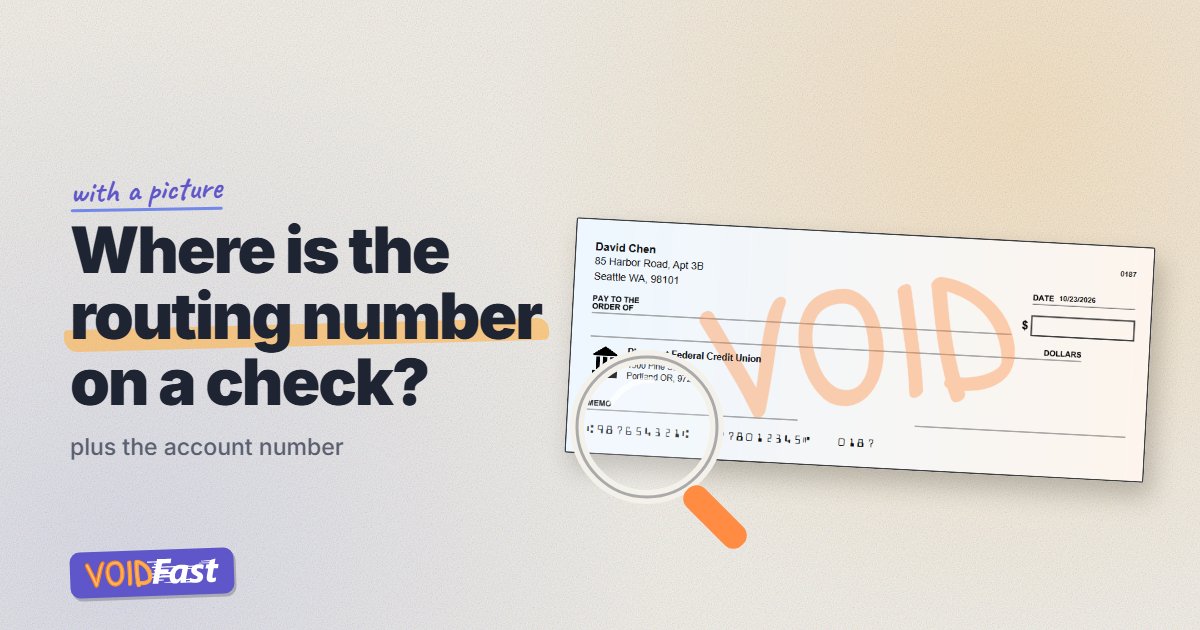
You're filling out a direct deposit form, setting up a bill payment or adding a bank account to an app — and it asks for your routing number and account number. Both are printed on every check you have. Here's exactly where to find them, how to tell them apart, and what to do if you don't have any checks.
Quick answer: the routing number is the first group of numbers at the bottom left of a check. It's always 9 digits and sits between two ⑆ symbols. The account number is the second group, right after it, and the last group is the check number.
How to read the numbers at the bottom of a check
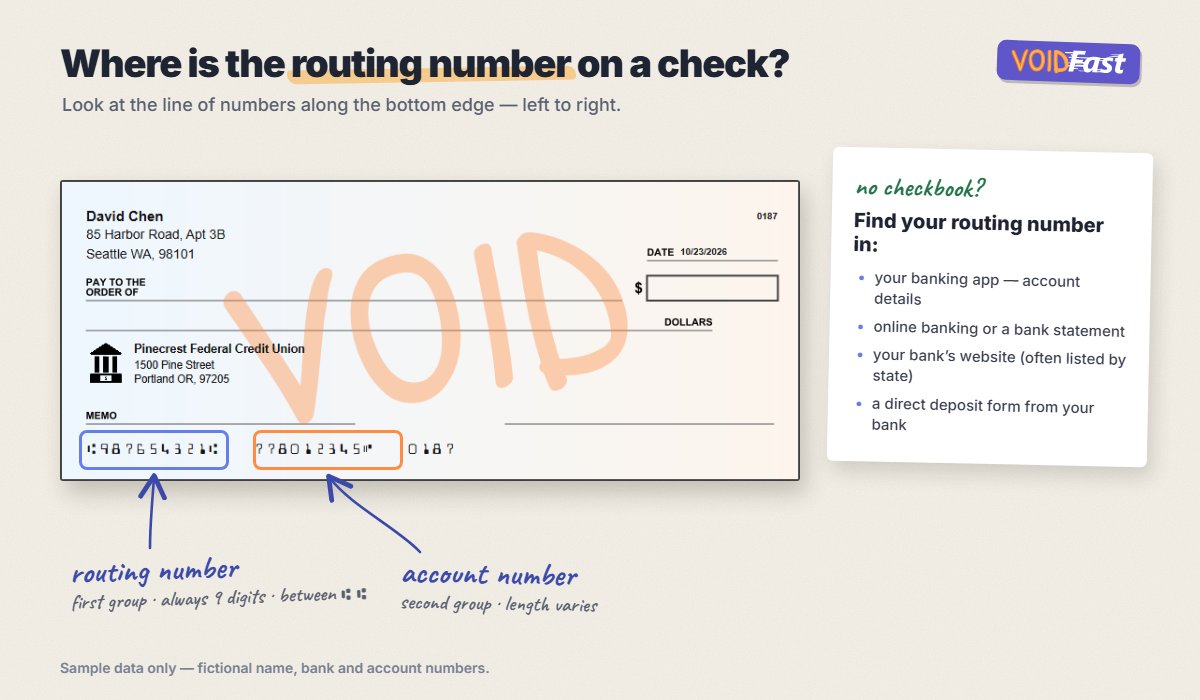
The line of numbers along the bottom edge is called the MICR line — it's printed in a special magnetic ink so bank machines can read it. On most personal checks it has three groups:
- Routing number — 9 digits, between the ⑆ symbols. It identifies your bank or credit union.
- Account number — usually 8 to 12 digits, followed by the ⑈ symbol. It identifies your account.
- Check number — the same number printed in the top right corner of the check.
On some checks — especially business checks — the order is different and the check number comes first. The routing number is always the one with exactly 9 digits between the ⑆ symbols, so look for that.
Routing number vs account number: how to tell them apart
- Length: a routing number is always 9 digits. Account numbers vary in length.
- Symbols: the routing number is framed by ⑆ on both sides; the account number ends with ⑈.
- Who has it: everyone at your bank (or your bank's region) shares the same routing number. Your account number is unique to you.
- Check number match: if a group matches the number in the top right corner, it's the check number — not your account number.
How to find your routing number without a check
No checkbook? You can still find both numbers in a few minutes:
- Banking app: open the account and look for "account details," "account info" or "routing number."
- Online banking: the same details are usually shown on the account summary page.
- Bank statement: many statements show the full account number and the routing number.
- Your bank's website: most banks publish their routing numbers. Large banks often have different routing numbers by state, so pick the state where you opened the account.
- A direct deposit form from your bank: often downloadable from online banking, with both numbers pre-filled.
- Call your bank: after verifying your identity, they can confirm both numbers.
You can also look up your bank on our list of US banks and credit unions.
Which routing number should you use?
For direct deposit, automatic bill payments and transfers, use the routing number printed on your checks or shown in your banking app. For wire transfers, some banks use a different routing number — check before you send a wire. We explain the difference in ACH vs wire routing number.
Be careful with deposit slips: the routing number printed on a deposit slip isn't always the one used for direct deposit.
Need to share the numbers? Use a voided check
When an employer or company asks for your routing and account number, they often want a voided check — a check with "VOID" written across it, so the numbers can be copied without the check being cashed. See how to void a check, or if you don't have checks, generate a voided check online with VoidFast — it prints your routing and account number in the correct format, just like the check above.
Frequently asked questions
Which number is the routing number on a check?
The first group of 9 digits at the bottom left, between two ⑆ symbols.
Where is the account number on a check?
In the bottom line, right after the routing number. It's usually 8 to 12 digits and ends with the ⑈ symbol.
Is the routing number the same for everyone at my bank?
Often, yes — but large banks may use different routing numbers by state or region. Use the one for the state where you opened your account.
Is the check number part of my account number?
No. The check number is the last group on the bottom line and matches the number in the top right corner. Don't include it when you enter your account number.
Can I find my routing number in my banking app?
Yes. Most banking apps show the routing number and full account number under the account details.
Is it safe to share my routing and account number?
It's normal to share them with your employer or companies you pay, through their official channels. Don't share them with anyone who contacts you unexpectedly.